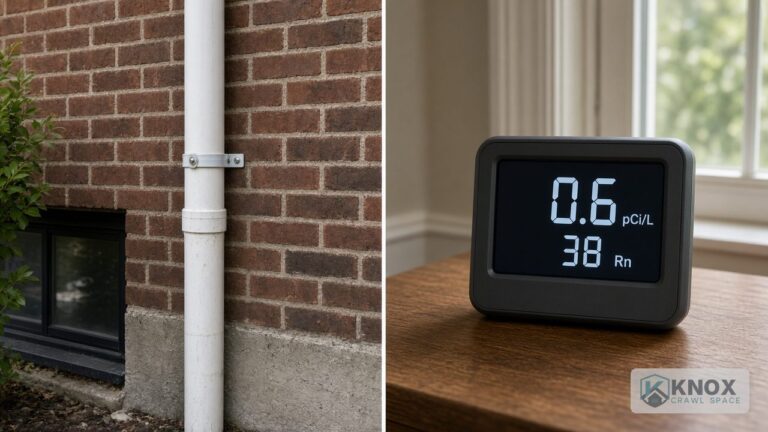
If a confirmed test shows 4 picocuries per liter (pCi/L) or higher, yes. That’s the EPA’s action level. Between 2 and 4 pCi/L, the EPA says to consider a fix, because no level of radon is risk-free. Under 2? Keep the result on file and retest every two years, which is what Tennessee’s radon program recommends.
One catch. A single test isn’t always enough to decide, so here’s how to confirm your number before you spend money on it.
What does my radon number mean?
| Your result | What the EPA says | What to do next |
|---|---|---|
| Under 2.0 pCi/L | Low, though not zero risk | File it. Retest in 2 years, or after a renovation or HVAC change. |
| 2.0 to 3.9 pCi/L | “Consider fixing” | Retest to confirm, ideally long-term, then decide (see below). |
| 4.0 to 7.9 pCi/L | Action level: fix the home | Confirm with a follow-up test, then get a mitigation quote. |
| 8.0 pCi/L or higher | More than twice the action level | Run a second short-term test immediately, then fix. |
Sources: EPA, A Citizen’s Guide to Radon (2025 edition); TDEC Tennessee Radon Program.
Should I retest before I pay for mitigation?
Usually, yes. The exception is a real estate deal, which we’ll get to.
Here’s how the EPA lays it out for homeowners (A Citizen’s Guide to Radon). You start with a short-term test. If it reads 4 pCi/L or higher, the EPA says follow up “to be sure.” That follow-up can be a long-term test (more than 90 days) or a second short-term test. The long-term test better reflects your year-round level. The short-term one is faster. And if your first result was more than twice the action level, about 8 pCi/L or higher, the EPA says do the second short-term test right away.
Then you decide. If the long-term result is 4 or higher, fix the home. With two short-term tests, consider fixing if their average is 4 or higher. The higher the numbers, the more certain the answer.
Tennessee residents can get free short-term kits from the state (TDEC). Our free test kit guide covers placement and the most common mistakes.
Buying or selling a house? Real estate runs on a different standard, built for deadlines: a single 48-hour continuous monitor, or two short-term tests averaged. See radon in a Tennessee home sale.
A second test can come in lower or higher than the first, especially with short-term kits, because weather and closed-house conditions move the reading. That’s the point of confirming before you buy a system, except when a contract deadline forces the real-estate protocol instead.
Is radon between 2 and 4 bad?
It’s the gray zone. Honestly, it’s a judgment call.
The case for fixing is pretty strong. The EPA says “any radon exposure carries some risk; no level of radon is safe,” and it recommends considering a fix between 2 and 4. It also estimates that at 2 pCi/L over a lifetime, about 4 in 1,000 people who never smoked and about 32 in 1,000 smokers could get lung cancer (EPA, Health Risk of Radon). The World Health Organization sets the bar lower than the U.S. does. It recommends a national reference level of 100 Bq/m³, about 2.7 pCi/L (WHO), so a 3 pCi/L reading is under the U.S. action level but over WHO’s suggested level. And the EPA says “most homes today can be reduced to 2 pCi/L or below.”
The case for waiting is short. Short-term results swing with weather, season, and how the house was closed up, and a long-term test tells you more. Say you read 2.1 and a long-term test comes back at 1.5. You just saved the cost of a system.
So what tips it? Someone in the home smokes or used to (the EPA’s estimates show much higher risk for smokers). People spend lots of time on the lowest floor. Or a long-term test confirms the level. If any of those fit your house, we’d lean toward fixing.
Who’s most at risk from radon?
The EPA says your lung cancer risk from radon depends mostly on your home’s radon level, how much time you spend there, and whether you smoke or have smoked. At 4 pCi/L, it estimates about 7 in 1,000 never-smokers and about 62 in 1,000 smokers could get lung cancer over a lifetime of exposure.
You won’t notice it. Radon has no smell and causes no immediate symptoms, so a test is the only way to know your level.
This article isn’t medical advice. Talk to your doctor about lung cancer screening and personal risk.
Do Knoxville homes need radon mitigation more often?
More often than most U.S. homes, yes. Knox County is in EPA Radon Zone 1, the highest-potential category. In Tennessee Department of Health data, Knox County’s 872 home tests averaged 3.94 pCi/L, and in several Knoxville zips more than a third of tests were 4.0 or higher, including 37922, 37919, 37924 and 37914 (radon by zip). Statewide, about 1 in 4 homes requesting a free TDEC kit test above 4 (TDEC).
That makes testing more urgent here. It doesn’t mean your house has a problem. Our article on whether radon is high in Knoxville explains what the zip data does and doesn’t tell you.
A low result at a neighbor’s house doesn’t tell you much about yours. Radon moves through the soil and the foundation of each house on its own path, which is why the advice here is the same in every zip: test your own home.
Can I get radon down without a mitigation system?
Not reliably. The EPA doesn’t recommend sealing cracks alone as a fix. Opening windows dilutes radon for a while, but it isn’t practical year-round (nobody’s doing that in a Knoxville January), and the effect changes with the weather.
For crawl space homes, the EPA calls sub-membrane suction, a sealed liner over the dirt with a fan pulling from beneath, “the most effective way to reduce radon levels in crawlspace homes” (EPA Consumer’s Guide to Radon Reduction). Basements and slabs usually get sub-slab suction. Our walkthrough of how crawl space and basement systems are built explains both.
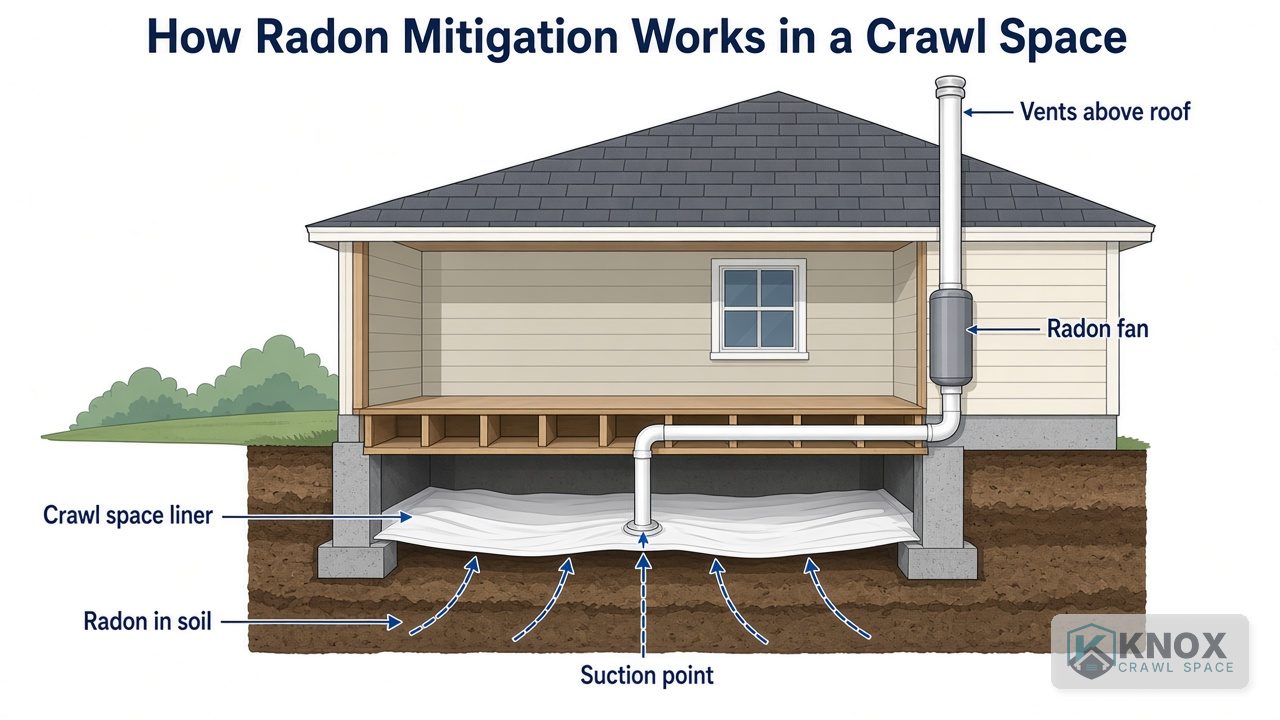
Cost is often the real question. Most Knoxville-area systems run about $800 to $2,500, and crawl space jobs often run $1,400 to $3,200 (estimates). The radon mitigation cost guide has the details.
How do I know the system actually worked?
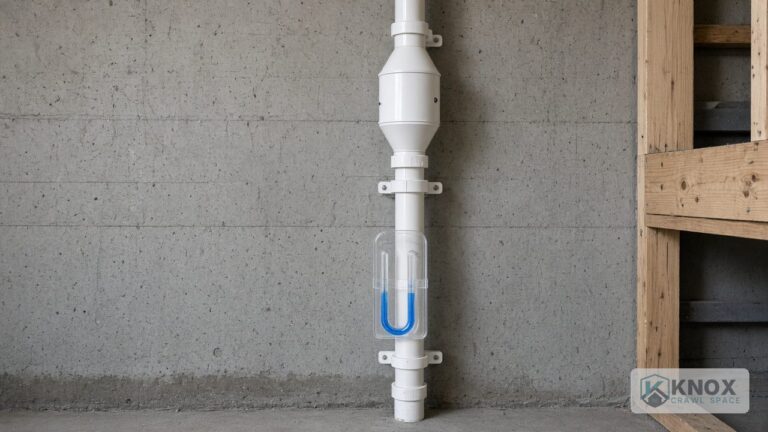
Test again. The EPA recommends a post-mitigation test no sooner than 24 hours and within 30 days after the system starts, ideally by an independent tester or by you. After that, retest at least every two years, and glance at the system’s gauge (usually a U-tube manometer) every so often.
Do I need radon mitigation? FAQ
Is 4.0 pCi/L the cutoff for needing mitigation?
It’s the EPA’s action level: at 4.0 or higher, fix the home. Below 4, the EPA says consider fixing between 2 and 4.
Is 3 pCi/L radon bad?
It’s below the U.S. action level but in the EPA’s “consider fixing” range, and above the WHO’s suggested reference level of about 2.7 pCi/L. A long-term test helps you decide.
Should I mitigate after one high test?
The EPA recommends a follow-up test first. If the first result was 8 pCi/L or higher, do the second short-term test immediately.
Can a radon level change over time?
Yes. Levels vary by season and with changes to the house, like new HVAC or renovations. TDEC recommends retesting every two years.
Does every Knoxville home need a radon system?
No. Plenty of homes test low. But Knox County is EPA Zone 1, so every home should be tested.