Most radon systems around Knoxville cost about $800 to $2,500 installed. Crawl space homes that need a sealed plastic membrane usually land somewhere between $1,400 and $3,200. Big or complicated houses can hit $4,000 or more.
Those are estimates, pulled from prices local mitigators post online and what homeowners report paying. Your number comes down to your foundation, where the pipe can run, and how much membrane the job needs.
How we got these numbers: In November 2026 we went through prices posted by Knoxville-area radon companies, a 2026 Tennessee radon cost guide, and prices homeowners reported for local jobs. Nobody publishes a true Knoxville average. So treat every range below as an estimate, not a quote.
What does a radon system cost for my kind of house?
| Your house and typical system | Estimated installed cost |
|---|---|
| Basement or slab, one suction point, pipe outside the house Sub-slab depressurization |
$900 to $1,900 |
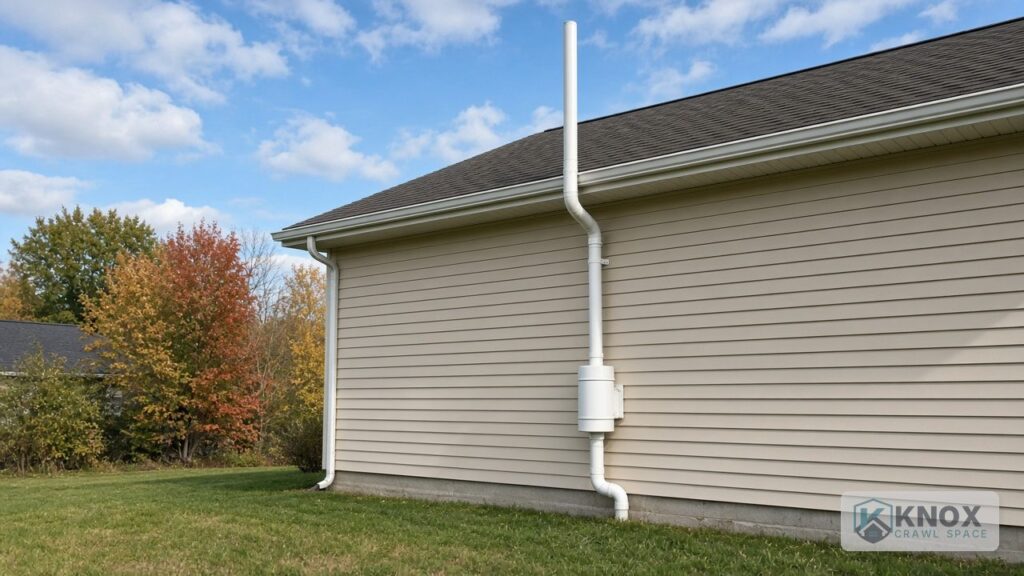
| A “standard” system as local companies price it One suction point, fan, gauge, exhaust above the roof. Price posted by one local company, plus diagnostics and a post-test. |
About $1,600 to $1,800 |
| Crawl space with a dirt or gravel floor Sub-membrane depressurization (sealed liner plus suction) |
$1,400 to $3,200 |
| Large crawl space that needs a heavy new liner over all of it Sub-membrane with full-coverage liner. One local company prices liner at about $3 to $4 per sq ft, plus the system. |
Can exceed $4,500 |
| Multiple foundations, finished basement, attic pipe route, or very high readings Multiple suction points or a larger fan |
$2,500 to $4,000+ |
All figures are estimates as of November 2026. The contractor sets the actual price after seeing your house.
Why are radon quotes so different from each other?
It starts with the foundation
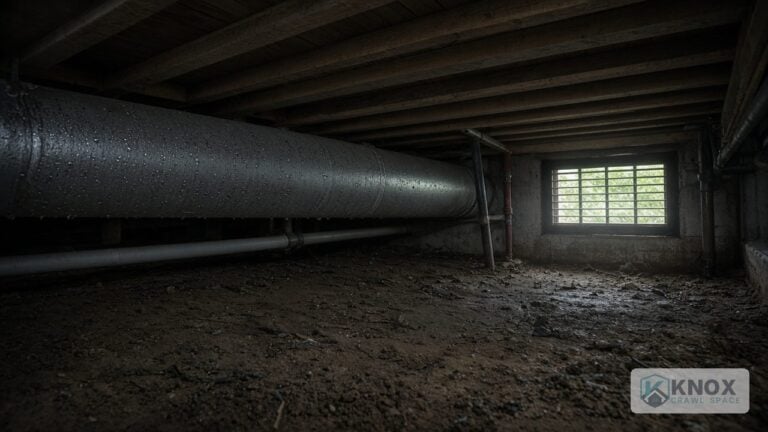
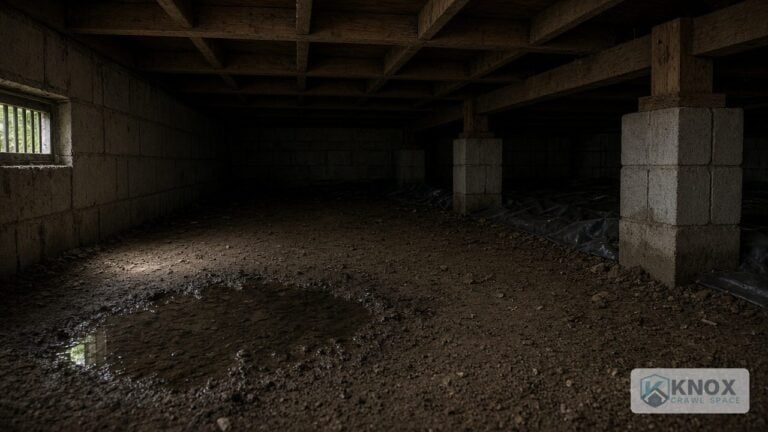
The EPA’s Consumer’s Guide to Radon Reduction is clear that the method depends on how the house is built. Basements and slabs usually get a suction point drilled through the concrete. Crawl spaces get sub-membrane suction: plastic sheeting sealed over the dirt with suction underneath, which the EPA calls “the most effective way to reduce radon levels in crawlspace homes” (EPA). That membrane, plus the labor to seal it, is why crawl space jobs tend to cost more. For the design itself, not just the price, see how a system is laid out for your foundation type.
Many Knoxville-area homes mix foundations. Basement under part of the house, crawl space under the rest. Each area may need its own suction point.
Split foundations are common enough in this market that a thorough quote should say, clearly, how each area will be treated. If a bid is silent on the crawl space side or the basement side, that’s a reason to ask before you sign, not after the crew shows up.
The membrane is the big swing
If your crawl space already has a sealed, intact vapor barrier or a full encapsulation, the radon system can often use it. That saves real money. If the liner’s torn, thin or missing, the contractor has to put one in, and that’s the single biggest swing in crawl space radon prices. Weighing both projects? Our guides to vapor barrier options and what a complete encapsulation includes can help.
Smaller things that still move the price
Pipe route, for one. Running up an outside wall is usually cheapest. Going up through a closet into the attic looks cleaner but takes more labor, and finished basements often force a longer route.
Some contractors also run a pressure-field test before designing the system. Locally that’s anywhere from $0 to about $300, and some companies credit it toward the install.
Then there’s power. The fan runs 24/7. If there’s no usable outdoor outlet, a licensed electrician may need to add a circuit or disconnect, and that work may need a permit.
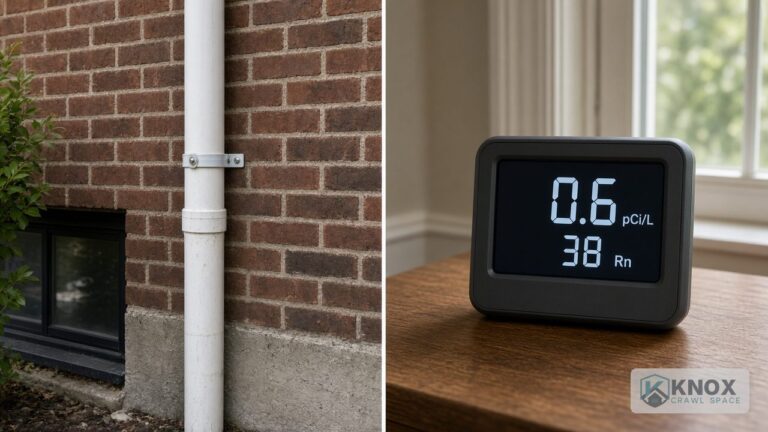
Your radon level matters less than you’d guess. Very high readings don’t always cost more. They can call for a stronger fan or extra suction points to get the house under the EPA’s 4.0 pCi/L action level, though.
Is a $3,000+ radon quote a red flag in Knox County?
Not necessarily. It does change what you should ask for.
Under Tennessee law, a residential job in Knox County that costs more than $3,000 and less than $25,000 requires a Tennessee Home Improvement license or a contractor license (Tennessee Board for Licensing Contractors). Large crawl space radon jobs can cross that line. Ask for the license number and look it up yourself. Our page on Knox County contractor license rules explains the thresholds.
Radon certification is its own question. Tennessee doesn’t license radon mitigators at all, so TDEC points homeowners to the national NRPP and NRSB certification directories (TDEC Radon Program). Get the certification number. Check it there.
What should a fair radon quote actually include?
Compare quotes line by line. The bottom number alone won’t tell you much. The EPA recommends getting estimates from one or more qualified contractors and weighing operating cost too, because “a less expensive system may cost more to operate” (EPA Consumer’s Guide).
A good quote spells out the design: how many suction points, the pipe route, the fan model, and where the exhaust ends (above the roof edge, away from windows). For a crawl space it should give the membrane’s square footage and thickness, and say how it’s sealed at walls and piers. Look for a system gauge, usually a U-tube manometer, so you can see the fan’s actually pulling. And it should say who handles electrical work and permits, and whether that’s included.
Then the back end of the job. The EPA says the post-mitigation test should happen no sooner than 24 hours and within 30 days after the system starts, and it recommends an independent test to avoid a conflict of interest. What if that retest comes back high? The quote should say whether the contractor comes back at no cost, and how many times. It should list warranties, both the fan maker’s (the EPA notes fan warranties “tend not to exceed five years”) and the contractor’s labor warranty. And it should show the total price including taxes and permit fees, which the EPA specifically lists as something to get in writing.
If a quote is vague about the retest, we’d keep shopping.
The gap between a solid quote and a weak one is usually in the scope, not the bottom number. Missing membrane square footage, a vague pipe route, or no mention of who handles the retest are the details that turn a cheap bid into an expensive surprise.
What does a radon system cost to run each year?
The EPA says fan systems “will slightly increase your electric bill.” Rough math: a fan drawing 50 to 90 watts around the clock uses about 440 to 790 kWh a year. At an assumed rate of about 12 cents per kWh, that’s roughly $50 to $95 a year. You also lose some heated or cooled air, which the EPA says can raise utility bills depending on the system and the house.
And when the fan quits?
It will, eventually. They run nonstop. Published replacement prices are all over the place. The EPA’s FAQ page puts a replacement at around $200 to $350 including parts and labor (EPA), which looks dated next to current fan prices. One Knoxville-area company posts $650 to $900 (November 2026). Figure roughly $300 to $900 depending on the fan and access (estimate).
Check the gauge regularly. If both sides of the U-tube read level, the fan may have stopped.
Retesting is the cheap part. TDEC recommends every Tennessee home retest every two years, even with a system (TDEC), and Tennessee residents can request a free state test kit.
Is radon mitigation more expensive in Knoxville than other places?
Hard to say, because there’s no official benchmark. The EPA’s current Consumer’s Guide (2025 edition) doesn’t give a dollar range. It just says most homes can be fixed “for about the same cost as other common home repairs.”
In our price review, the biggest local swing wasn’t labor rates. It was foundation type. Crawl space systems need membrane, and basements and slabs usually don’t.
What’s clearly different here is demand. Knox County has 872 tests on record averaging 3.94 pCi/L, and several Knoxville zips average above 4.0. See your zip’s readings.
How can I get the price down?
The best way is to pair it with crawl space work you already need. If you’re encapsulating anyway, the same sealed liner can serve the radon system, and doing both at once usually costs less than doing them separately.
Beyond that, get two or three written quotes with the same scope so you’re comparing like for like. Not on a deadline? Use the free state kit first and confirm a high result before you buy a system (see Do I need radon mitigation?). And if you’re selling, testing before you list puts you in control of timing and price, instead of negotiating under a buyer’s deadline (see our home-sale radon testing guide).
Radon mitigation cost FAQ
How much is a radon system for a crawl space in Knoxville?
Usually about $1,400 to $3,200 (estimate), depending mostly on how much sealed liner the crawl space needs. Big crawl spaces that need a full new heavy liner can go past $4,500.
Is radon mitigation worth the money?
If your confirmed level is at or above 4.0 pCi/L, the EPA recommends fixing the home. The EPA estimates that at 4 pCi/L over a lifetime, about 7 in 1,000 people who never smoked and about 62 in 1,000 smokers could get lung cancer (EPA, Health Risk of Radon). Systems can cut radon levels by up to 99 percent, per the EPA.
How long does installation take?
Most single-family systems go in within one to two days. Membrane-heavy crawl space jobs can take longer.
Does homeowners insurance pay for radon mitigation?
Standard policies generally don’t, but read your policy or ask your agent.
Can I install a radon system myself?
The EPA recommends a qualified contractor. If you do it yourself, it says to get guidance from your state radon office first. In Tennessee, that’s the TDEC Radon Program hotline at 1-800-232-1139.
What does a radon fan replacement cost?
Roughly $300 to $900 installed (estimate). The EPA’s FAQ says about $200 to $350, and one Knoxville-area company posts $650 to $900 (November 2026). Fan warranties rarely go past five years, per the EPA.