Not by itself, no. A sealed liner can slow down radon coming up out of the soil. But encapsulation also closes the vents that were diluting radon under the house, so your levels can stay flat or even go up.
The method the EPA calls most effective for crawl space homes adds a fan that pulls soil gas from under the liner and sends it out above the roof. So if you’re encapsulating in Knox County, where radon is common, test before and after, and plan the radon system together with the liner instead of tacking it on later.
Why doesn’t encapsulation fix radon on its own?
Two things happen when you seal up a vented crawl space, and they pull in opposite directions.
First, the liner covers the dirt. That cuts down on radon moving straight from the soil into the crawl space air. Good.
Second, the vents get closed. The EPA notes that crawl space ventilation “may lower indoor radon levels both by reducing the home’s suction on the soil and by diluting the radon beneath the home” (EPA Consumer’s Guide to Radon Reduction). Encapsulation gets rid of that dilution on purpose, since humid outside air is what’s causing the moisture problems to begin with.
Which effect wins? It depends on the house and how well the liner’s sealed, and you can’t predict it without a test. Also keep in mind that a moisture liner isn’t designed or sealed as a radon barrier. Gaps at piers, walls and plumbing let soil gas right through.
That’s why a before-and-after test is the only way to know what encapsulation did in a given house. The same liner job can lower radon in one crawl space and leave it flat, or higher, in another.
So what actually brings radon down in a crawl space?
The EPA describes three approaches for crawl space homes. They’re not equal.
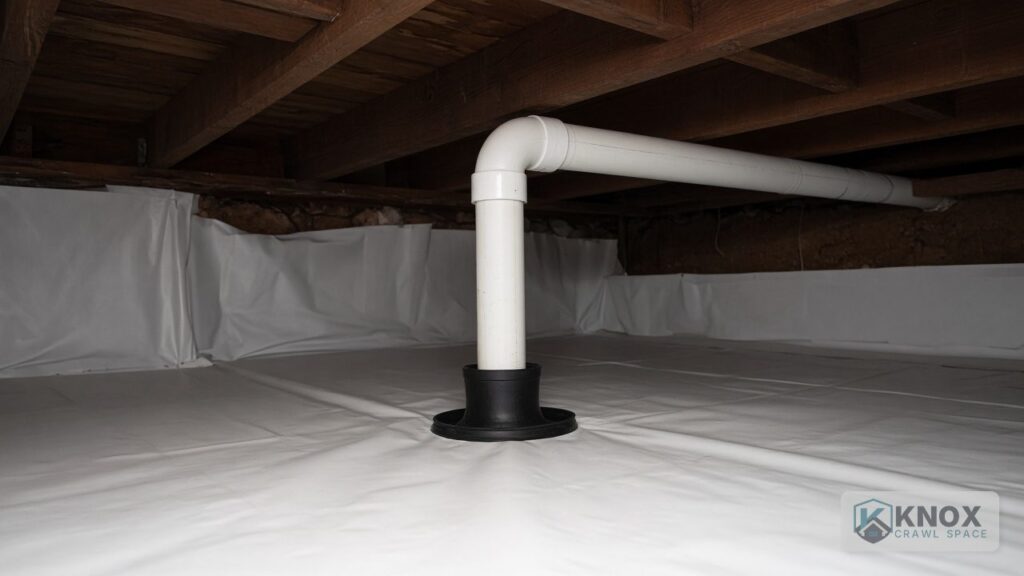
Sub-membrane suction is the one it rates highest. Plastic sheeting goes over the dirt floor, and a pipe and fan pull radon from under the sheet and vent it outdoors. The EPA says that “when properly applied,” this is “the most effective way to reduce radon levels in crawlspace homes.”
Active crawl space depressurization uses a fan to pull air out of the whole crawl space. According to the EPA it “generally does not work as well,” it needs attention to combustion appliance backdrafting, and it can raise energy costs.
Then there’s plain ventilation, meaning open or added vents, or a fan blowing outside air through. It can lower radon in some cases but may raise energy costs. It’s also the exact opposite of encapsulating, so if you’re reading this, it’s probably off the table.
For an encapsulated crawl space, then, the answer is sub-membrane suction. Your encapsulation liner becomes the membrane, and a radon fan keeps the soil under it at negative pressure. Our walkthrough of how a sub-membrane system is built shows the layout.
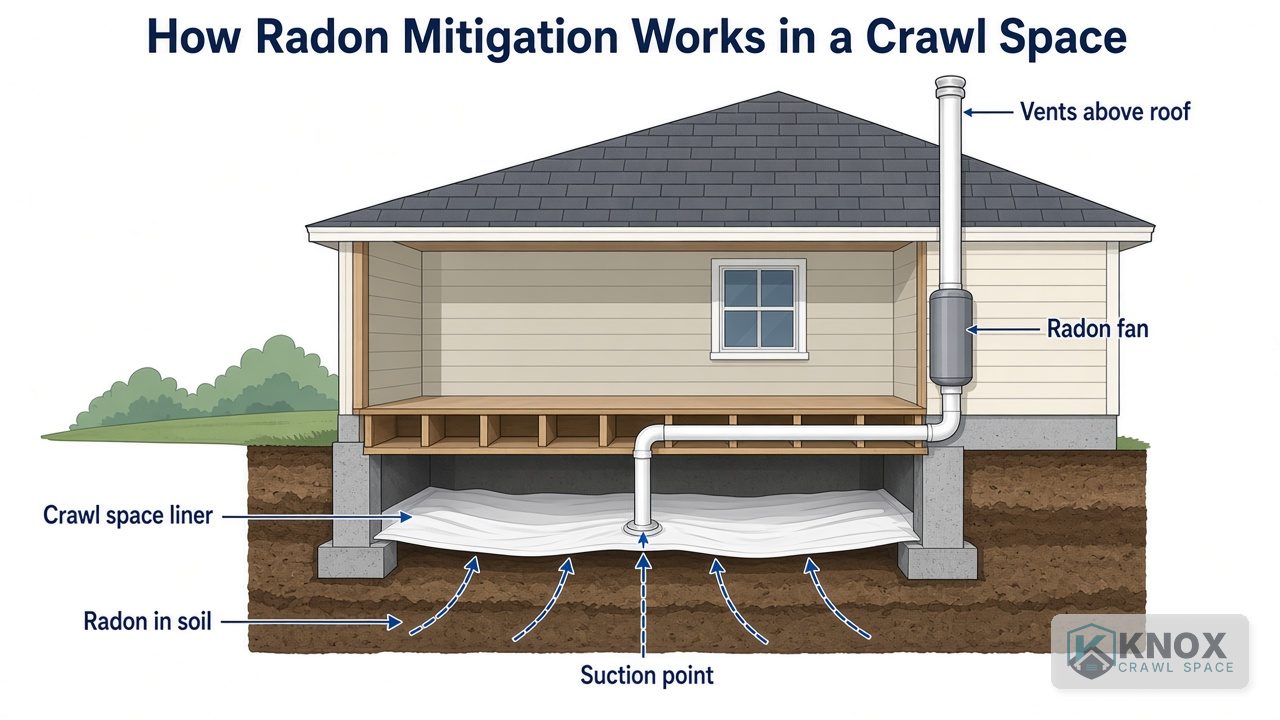
Is this a bigger deal in Knoxville?
It is. Knox County is in EPA Radon Zone 1, the highest-potential category. In Tennessee Department of Health data, Knox County’s 872 home tests averaged 3.94 pCi/L, and several Knoxville zips have more than a third of tests at or above the EPA’s 4.0 action level (radon by zip). Blount, Loudon and Sevier run higher.
At the same time, encapsulation is popular here for its own reason. East Tennessee summers are humid (our crawl space dehumidifier guide gets into that). Plenty of local homeowners are dealing with both problems at once. If you’re pricing the moisture work on its own, start with what a complete encapsulation includes.
Worth knowing: Knox County Code Administration has its own radon handout. It’s written for new construction, but for conditioned crawl spaces it describes the same basic idea. Sheeting over the crawl space floor and “up the stem walls 12 [inches] with all joints taped,” plus a vent pipe that ends at least 12 inches above the roof (Knox County Codes, Radon Control Methods). That’s a new-construction guideline, not a retrofit standard. Still, it tells you the county takes radon under sealed crawl spaces seriously.
Should I test for radon before I encapsulate?
Yes. Before and after.
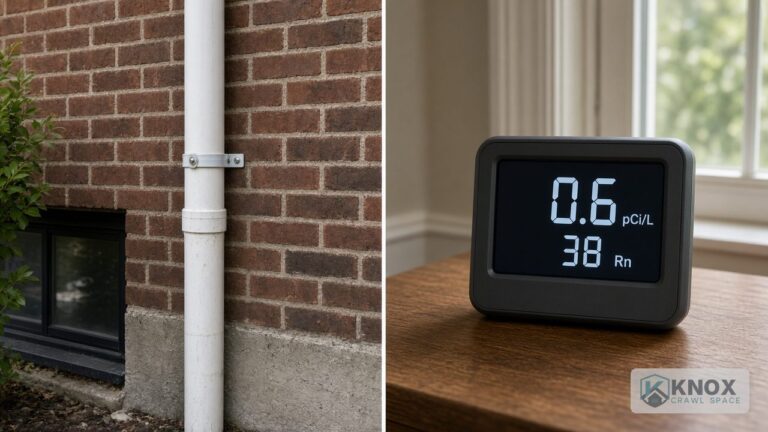
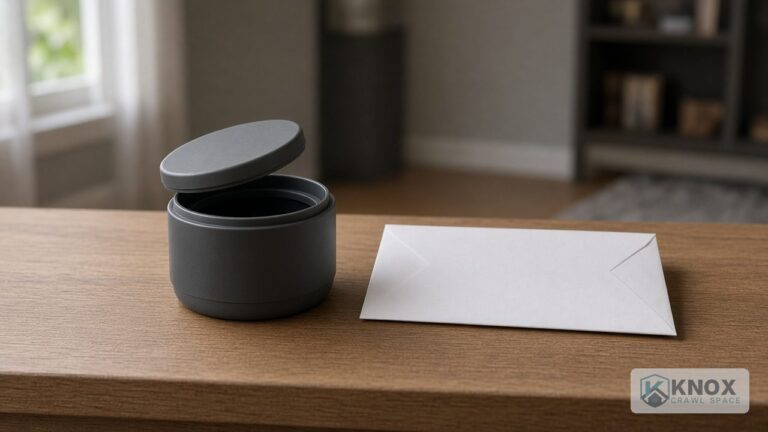
The before test is your baseline. It tells you whether radon suction should be part of the job from day one. Tennessee residents can get a free state test kit.
The after test comes once the crawl space is sealed and the dehumidifier’s running. The EPA advises testing before a major renovation, and says that because “major renovations can change the level of radon in any home, always test again after work is completed” (EPA, A Citizen’s Guide to Radon). TDEC also recommends every Tennessee home retest every two years.
If your before test is already at or above 4.0, plan on sub-membrane suction as part of the encapsulation. If it’s low, ask the contractor to leave a sealed suction point or capped pipe stub under the liner. That way a fan can go in later without anybody cutting your brand-new liner.
Doing both at once? Here’s what the quote should cover
If the crawl space needs encapsulating and the radon test is high, doing both in one project usually costs less than doing them separately. The liner is the most expensive part of a crawl space radon system, and you’re paying for it either way.
On the physical side, ask for:
- A liner sealed for radon, not just moisture. Seams taped, edges sealed to walls and piers, penetrations sealed.
- Suction under the liner, using a perforated pipe or suction pit connected to a radon-rated fan.
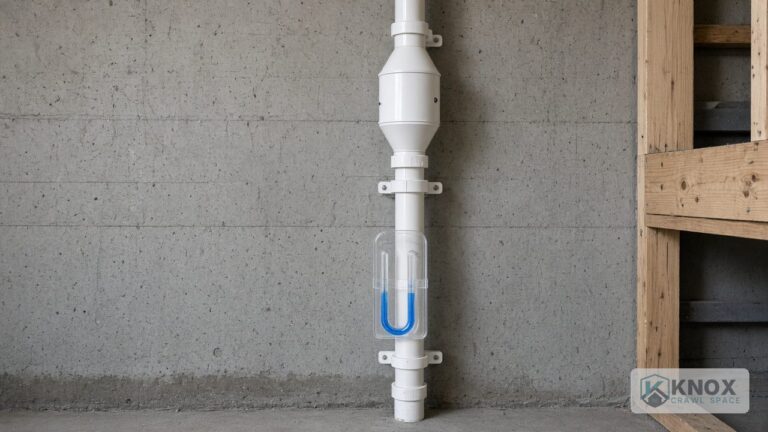
- An exhaust above the roofline, away from windows and doors. Not out a crawl space vent.
- A system gauge (U-tube manometer) and a label on the pipe.
Then the paperwork. You want a post-mitigation radon test no sooner than 24 hours and within 30 days after the fan starts, and the EPA recommends an independent test.
Licensing matters here too. Combined jobs in Knox County will almost always top $3,000, and residential work over $3,000 and under $25,000 requires a Tennessee Home Improvement or contractor license (tn.gov). Ask for the license number. Our Knox County license rules page explains it. Radon certification is a separate check, because Tennessee doesn’t license radon mitigators. TDEC points homeowners to the NRPP and NRSB directories (TDEC).
As for money (estimates): our encapsulation cost guide puts a complete Knoxville encapsulation at roughly $5 to $10 per square foot. A crawl space radon system on its own often runs $1,400 to $3,200 (radon mitigation cost guide). When the liner’s already part of the encapsulation, the added radon cost is mostly the suction, pipe, fan and electrical work.
Doing the two jobs on separate timelines usually means paying for access and prep twice. A single scope that covers the liner and the suction at once is the cleaner path, and it’s the one to ask for if both problems are already on the table.
Will a radon fan mess with my dehumidifier?
It shouldn’t. A properly designed sub-membrane system pulls from under the liner, not from the crawl space air, so it isn’t sucking your dehumidified air out of the crawl space.
The setup to be careful with is the other one. The EPA cautions that depressurizing the whole crawl space can cause combustion appliance backdrafting and higher energy costs. Got a furnace or water heater down there? Ask the contractor how their design avoids that.
Crawl space encapsulation and radon: FAQ
Does a vapor barrier reduce radon?
A sealed barrier can reduce soil-gas entry, but on its own it isn’t a reliable radon fix. The EPA’s most effective method for crawl spaces adds suction under the barrier.
Can encapsulation increase radon levels?
It can. Closing the vents removes the dilution the EPA says ventilation provides. Test before and after.
Is it cheaper to do radon mitigation and encapsulation together?
Usually, because the liner does double duty. Get one written scope that covers both.
What radon level means I need a fan under my encapsulation?
At 4.0 pCi/L or higher, the EPA recommends fixing the home. Between 2 and 4, it recommends considering a fix. See Do I need radon mitigation?
Does the radon pipe have to go through the roof?
The exhaust should end above the roofline, away from windows and doors. It can run up the outside of the house or through the interior to the attic.