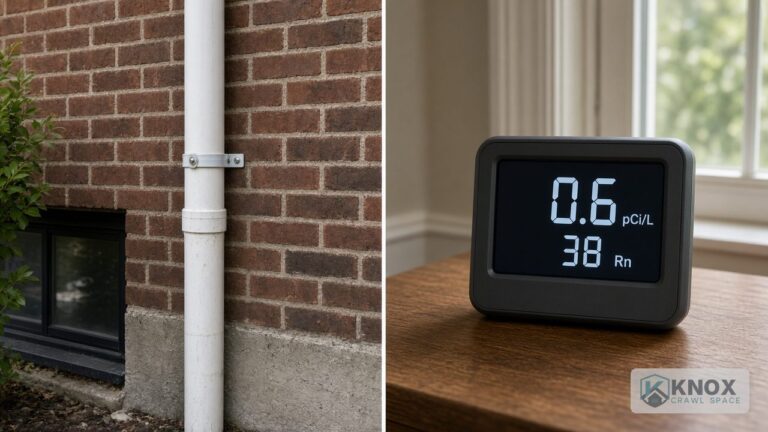
Tennessee doesn’t make you test for radon to buy or sell a house. The state’s disclosure form does ask the seller whether they know of radon gas on the property, though. And around here, most buyers test during the inspection period anyway. If the result comes back at or above 4.0 pCi/L, it usually gets settled like any other repair. Most of the time the seller puts in a system before closing. Sometimes it’s a credit or a lower price instead.
Who pays? No Tennessee law says. That’s for the two sides to work out.
Below is what the law actually requires, which tests the EPA accepts for real estate, and how to handle a bad number without losing your closing date.
This is general information, not legal advice. Your purchase contract and your agent or attorney control the details.
Does Tennessee require a radon test to sell a house?
Testing? No. There’s no mandatory radon test for home sales in Tennessee.
Disclosure is a different story. Under the Tennessee Residential Property Disclosure Act, someone selling a one-to-four-unit home generally gives the buyer either a disclosure statement or, if the buyer waives it, an “as is” disclaimer (Tenn. Code Ann. § 66-5-202). The statutory form asks whether the seller is aware of “substances, materials or products which may be an environmental hazard such as… radon gas,” with boxes for Yes, No, or Unknown (form text, Tenn. Code Ann. § 66-5-210).
Here’s the catch. That same statute says the owner isn’t required to do “any independent investigation or inspection.” So a “No” or “Unknown” on the radon line often just means nobody ever tested the house. It doesn’t mean it tested clean. Which is exactly why buyers run their own test.
A clean-looking disclosure is not the same thing as a clean test. The form records what the seller knows, not what the air in the house is doing, and a lot of houses around here have never been tested at all.
Why does everybody in Knoxville test for radon during inspection?
Because it’s common here. Really common.
TDEC reports that about 1 in 4 homes that request a free state test kit come back above 4 pCi/L (TDEC Radon Program). Pull up the Tennessee Department of Health numbers on our radon-by-zip page and you’ll see several Knoxville zips averaging above the 4.0 action level. In 37922, 38% of 131 tests hit 4.0 or higher. In 37919 it was 40% of 63 tests. Those come from homes that chose to test, not a random sample, so take them as a signal rather than gospel. Still, it’s easy to see why agents and inspectors in town treat a radon test as standard.
Which radon tests count when you’re buying a house?
The EPA’s Home Buyer’s and Seller’s Guide to Radon (revised March 2024) gives three short-term options for when a sale needs answers fast (EPA).
Two of them use passive tests. You can run two devices at the same time, side by side in the same spot, for at least 48 hours. Or run them back to back: one for at least 48 hours, then an identical device in the same spot right after. Either way, if the two average 4 pCi/L or more, the EPA says fix the home. The third option is a single continuous (active) monitor running at least 48 hours, and the rule’s the same. An average of 4 or more means fix it.
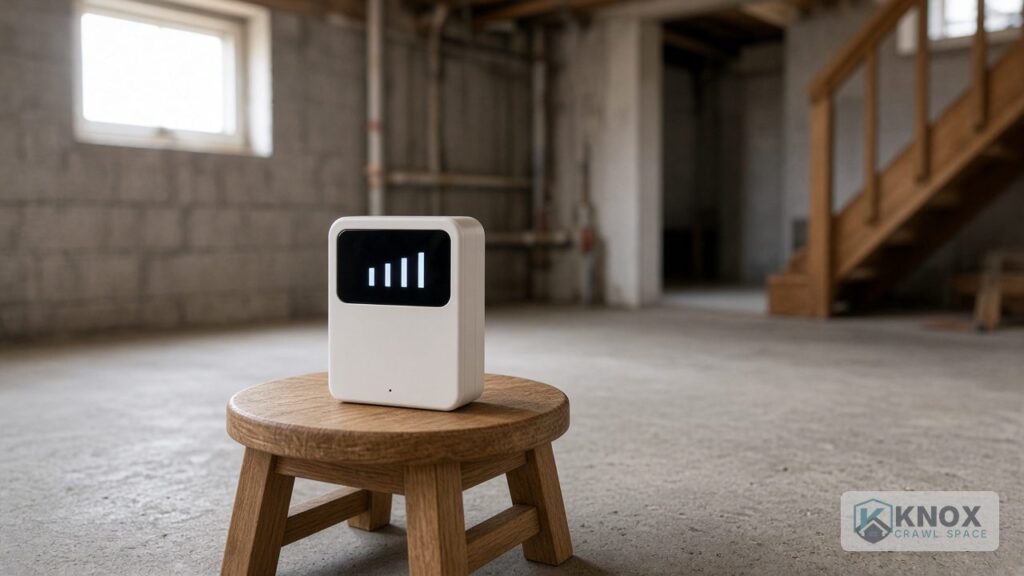
Most Knoxville deals go with the continuous monitor. You get an hour-by-hour report within about two days of setup, which is what you want on a contract clock. The free mailed state kit is great for homeowners. On a deadline it’s the wrong tool (our free test kit guide explains why).
One more thing from the EPA that gets missed: test in the lowest level that could be used regularly. The buyer may end up using a basement or den the seller hardly touched.
Who should run it?
Tennessee doesn’t license radon testers, so you have to check credentials yourself. TDEC sends consumers to the NRPP and NRSB professional directories (TDEC). Ask the tester for a certification number. Then actually look it up.
Can a seller mess with a radon test?
They can try. That’s why the EPA says any real estate radon test “should include steps to prevent or detect interference.” It suggests a device that records frequently, so strange swings stand out, along with motion or proximity detectors, temperature and barometric pressure logs, and tamper-proof seals on windows. The low-tech safeguard is a non-interference agreement signed by the seller or whoever’s living there.
Closed-house conditions start 12 hours before the test. Windows and exterior doors stay shut, except for normal coming and going. Our day-by-day contract testing timeline covers the clock, so we won’t repeat it here.
The radon test failed. Now what?
Breathe. A result at or above 4.0 pCi/L rarely kills a deal. It just turns radon into a repair with a price tag.
The most common route is the seller hiring a mitigator and installing a system before closing, with the buyer getting a post-install test result. If you want the physical picture first, here’s what that system usually involves. If you go that way, insist on a certified installer, a written scope, and a post-mitigation test (more on that below).
A seller credit at closing is the other big one. The buyer gets money and has the system put in after moving in. Base the credit on a written quote, not a guess, and make sure your lender allows it. A price reduction works about the same. Price it off a real quote.
You’ll also see escrow or holdback arrangements, where money is held at closing until the work’s done. That only works if your lender and title company are on board, so ask early. And in competitive markets, sometimes the buyer just eats it. Even then, get the quote before your contingency runs out.
What are we talking, money-wise? Most Knoxville-area systems run about $800 to $2,500, and crawl space homes are often $1,400 to $3,200 (estimates). Our radon mitigation cost guide breaks it down.
How the two sides settle it usually comes down to the number, the written quotes, and how much time is left on the clock. The useful move is getting a real quote in hand before the inspection contingency runs out, so the negotiation is about a price, not a guess.
Is a result between 2 and 4 pCi/L a fail?
Not by the EPA’s action level. But the EPA also says levels under 4 “still pose a risk” and “in many cases, may be reduced,” and it recommends considering a fix between 2 and 4. So some buyers ask for a system anyway. That’s a negotiation. Nobody has to agree to it.
What if it’s sitting right at 4.0?
The EPA has a number for this. With two short-term tests averaging 4.1 pCi/L, there’s “about a 50 percent chance” the year-round average is slightly above or below 4. A coin flip, more or less. That’s a reason to talk it through, not to panic.
If the seller puts in a system, what should the contract say?
Get it in writing. Your agent or attorney drafts the actual language, but here’s what we’d want covered.
Start with who does the work. Tennessee doesn’t license mitigators, so ask for NRPP or NRSB certification. On bigger jobs, check the license too. In Knox County, a residential job over $3,000 (and under $25,000) requires a Tennessee Home Improvement or contractor license (tn.gov), and large crawl space radon jobs can cross that line. Our Knox County license rules page has the details.
Then the retest, which is the part we’d push hardest on. It should happen no sooner than 24 hours and within 30 days after the system starts. The EPA recommends an independent test, not just the installer’s own (EPA Consumer’s Guide to Radon Reduction).
At closing, the buyer should walk away with the post-test report, the install date, a system diagram or photos, the fan model and warranty, and the contractor’s labor warranty. Also leave yourself time. Most systems go in within a day or two, but the retest needs its own window.
Already looking at a house that has a system? Run through our five-point system check.
Selling? Should you test before you list?
We think so. The EPA recommends sellers test before listing and keep records of any fix, and it points out that a documented fix “could be a positive selling point.” Test early and you get to pick the contractor, the price, and the timing. Wait, and you’re doing all of it under a buyer’s deadline.
There is a trade-off. Once you know about elevated radon, the disclosure form asks about it. Talk with your agent or attorney about how to disclose your results and any system you put in.
Sellers who wait often end up hiring a mitigator on the buyer’s schedule, which is a more stressful way to do the same work.
Radon and home sales in Tennessee: FAQ
Do I have to test for radon to sell my house in Tennessee?
No. Tennessee law requires disclosing known conditions (or an “as is” disclaimer if the buyer waives disclosure). It doesn’t require testing.
Who pays for radon mitigation in Tennessee?
There’s no rule. It’s negotiated like any other inspection repair. The seller installs a system, gives a credit, or drops the price, or the buyer handles it.
How long does a radon test take in a home sale?
At least 48 hours under the EPA’s real-estate options, plus 12 hours of closed-house conditions beforehand. Continuous monitors usually report shortly after pickup.
Can I use the free Tennessee test kit when buying a house?
It isn’t built for deadlines. The state kit runs 3 to 5 days and gets mailed to a lab. Real estate tests usually use a certified tester with a continuous monitor.
Will a radon system delay closing?
Usually not, if you deal with it early. Installation typically takes a day or two, and the post-test needs at least 24 hours of system run time.
Does a radon mitigation system hurt resale value?
There’s no reliable public data either way. A working system with a passing post-test and the paperwork answers the question a future buyer will ask.